
Robotic Welding / Cobot Welding
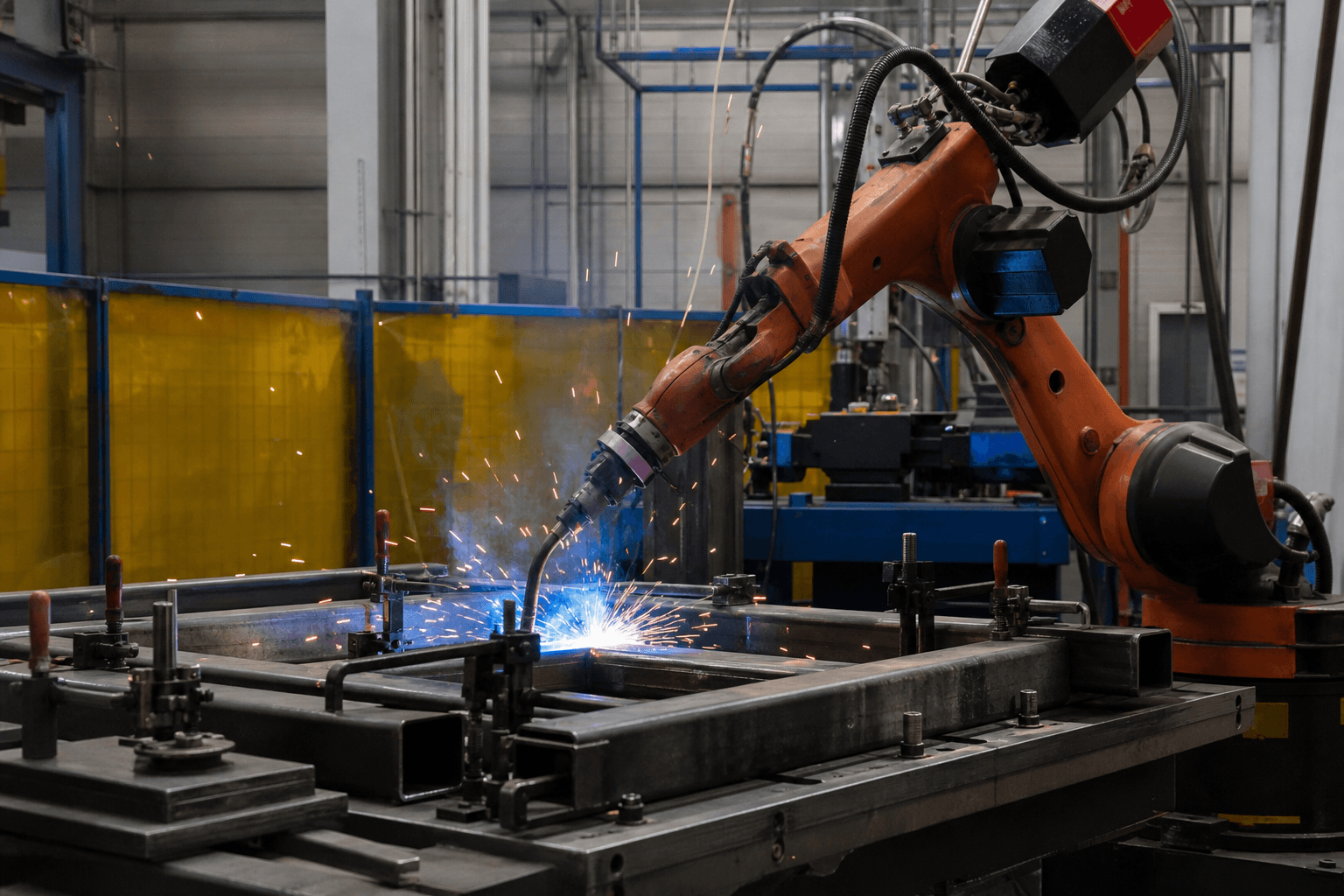
Automated MIG/TIG or cobot welding for repetitive seams, brackets, and structural assemblies.
Tell us about your welding process. If another approach fits your description better, we will say so.
Technology Overview
Automated MIG/TIG or cobot welding for repetitive seams, brackets, and structural assemblies.
Problems It Commonly Solves
- Welder shortage, weld variability, rework, and fume exposure on repetitive steel assemblies.
- Common application: Bracket welding
- Common application: Frame fabrication
- Common application: Cobot weld assist stations
Suitable Conditions
- Repeatable joint access with moderate fixturing investment
- Second-shift welder availability is a bottleneck
- Rework rate tied to operator variability
Constraints to Investigate
- Highly custom one-off assemblies with no repeat geometry
- Critical joints require certified manual welder sign-off only
- No feasible fume control path in existing bay layout
Project Readiness Check
These questions ask whether you already have the information. Answer yes, no, or not sure. A no means information to gather. It does not mean the automation opportunity failed.
1. Do you have representative parts that show the weld quality you need?
Why it matters: A real part is more useful than a general description of the joint.
2. Do you know how repeatable part fit-up and fixturing are today?
Why it matters: Fixture consistency is a major input for an automated weld.
3. Do you know the throughput target, including loading, unloading, and changeovers?
Why it matters: The full cycle, not only arc time, sets the comparison.
4. Do you know the ventilation, guarding, and site services at the bay?
Why it matters: Site services often change the project scope.
5. Do you know which quality or procedure standard the welds must meet?
Why it matters: The standard changes inspection and qualification work.
Inputs required for preliminary assessment
Checklist of core and supporting inputs for Robotic Welding / Cobot Welding. Copy, print, or save locally; open Studio to attach this Technology to an Automation Project.
Required core inputs
Optional supporting inputs
Evidence to gather
- Photos of current weld stations and fixtures
- Sample parts with joint access notes
- Weld quality complaints or rework rates
- Ventilation / booth drawings if available
This pathway is an early planning guide. It is not a final feasibility review, engineering design, safety certification, supplier quote, or statement of work.
Main Technical Variables
- Weld process (MIG/TIG/spot) and material
- Part geometry and joint access
- Production rate / takt
- Fixturing approach
- Fume / ventilation constraints
- Fixtures and clamps
- Fume extraction / booth
- Torch and wire-feed package
Typical Solution Stack
- Welding robot or cobot with torch and wire feed
- Fixtures and part presentation
- Fume extraction and ventilation
- Weld monitoring and recovery workflows
Required Delivery Roles
- Welding integrator
- Fixture designer
- Fume extraction partner
- Weld procedure reviewer
Common Cost Drivers
- Fixtures and clamps
- Fume extraction / booth
- Torch and wire-feed package
- WPS qualification and NDT
Cost and schedule usually move with: Fixtures and clamps; Fume extraction / booth; Torch and wire-feed package; WPS qualification and NDT. Treat any public ranges as illustrative planning context only. They are not a quote.
Common Project Risks
- Fixture repeatability insufficient for automated seam consistency.
- Weld procedure qualification scope expands beyond the initial part family.
- Ventilation upgrades required beyond robot cell budget.
Site-Readiness Considerations
- Adequate booth or cell space
- Gas and power supply confirmed
- Skilled welder available for validation sign-off
- Confirm fume capture at operator positions before design freeze.
- Validate applicable weld code / qualification requirements early.
Validation Activities
- Weld procedure qualification plan agreed
- Fixture repeatability measured on sample parts
Scope to Confirm With Suppliers
- Confirm which equipment, tooling, and software are included in the proposal.
- Confirm whether installation, commissioning, and operator training are included.
- Confirm which utilities, guarding, fixtures, and site work stay with your team.
- Confirm spare parts, documentation, and the support period.
- Confirm how acceptance will be tested before handover.
Example Acceptance Criteria
- Agree the test parts, rate, and quality checks before installation.
- Agree who signs off and what happens if a test is not met.
Questions to Ask Suppliers
- Can you demonstrate weld quality on our representative parts?
- What fixture accuracy and part consistency does the proposed process require?
- What throughput can the cell achieve with loading, unloading, and changeovers included?
- What ventilation, guarding, and site services will be required?
- What procedure qualification, inspection, and validation work is included?
- Who provides fixtures, programming, operator training, and commissioning?
- How will we define and verify acceptance criteria?
Related Automation Use Cases
Related Listed Providers
Browse listed providers related to this pathway in alphabetical order. Listings are basic public company information. They are not rankings, endorsements, fit scores, or recommendations.
Browse listed providers for this technologyInnovation Peer reviews your Automation Project privately with an Innovation Peer advisor. No supplier introduction happens without your approval.
Tell us about your welding process. If another approach fits your description better, we will say so.