
Robotic Screwdriving & Fastening
Automated screwdriving, nut driving, and mechanical fastening for assembly cells.
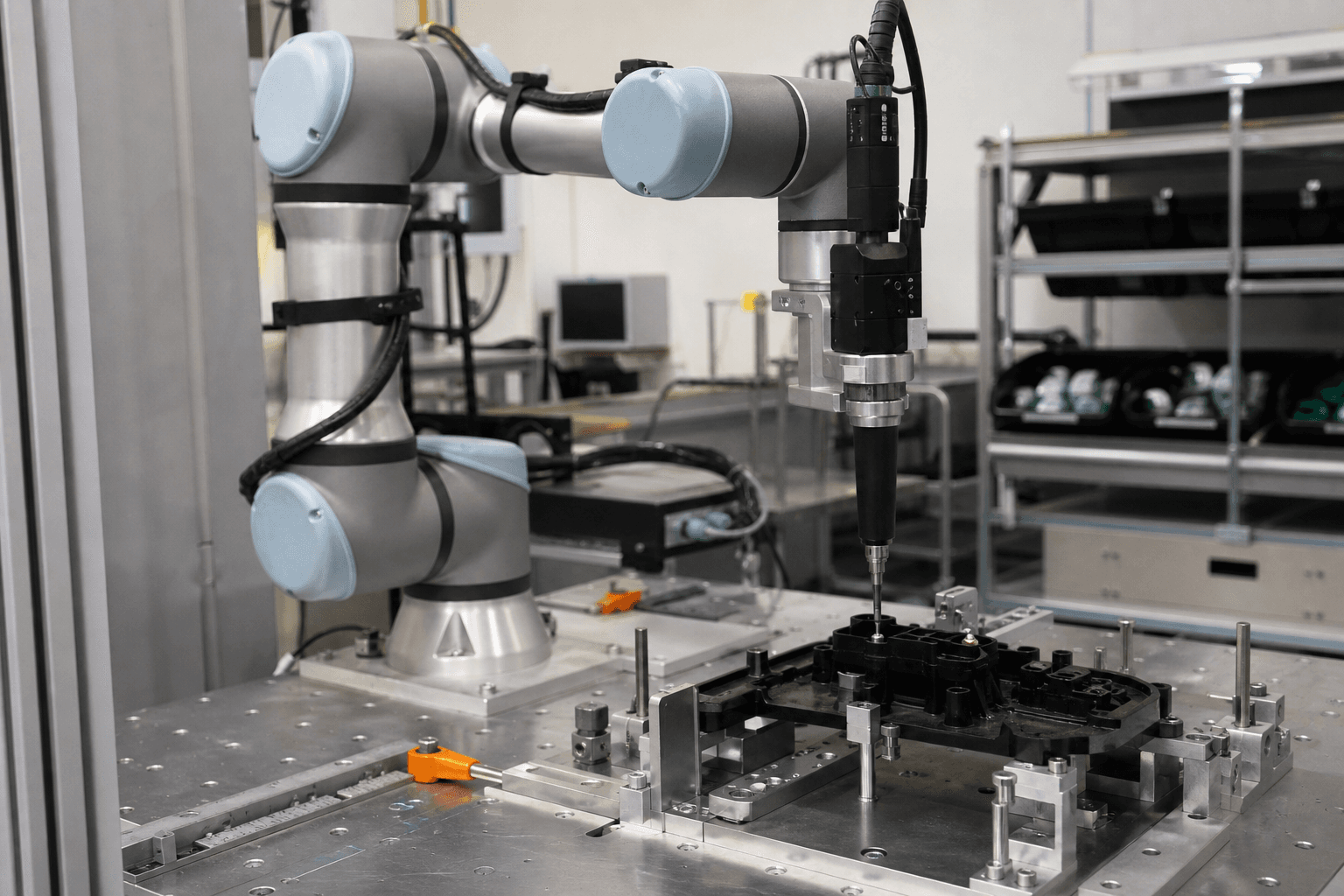
Assess this process with Robotic Screwdriving & Fastening as soft context — the classifier can still suggest a different Technology if your description points elsewhere.
Technology overview
Automated screwdriving, nut driving, and mechanical fastening for assembly cells.
Problems it commonly solves
- Manual fastening causes torque inconsistency, repetitive strain, and traceability gaps on assembly lines.
- Common application: Mated part screwdriving
- Common application: Nut runner stations
- Common application: Multi-fastener assembly cells
Best-fit operating conditions
- Defined fastening sequence with measurable torque requirements
- Manual fastening limits throughput or quality consistency
Poor-fit conditions
- Extreme daily variant mix without feasible quick-change fixturing
- Fastener access impossible within robot reach envelope
Five-question suitability screen
Answer yes, no, or unknown. Results are deterministic planning guidance — not final feasibility.
1. Is the target process repeatable enough to automate?
Why it matters: One-off or highly variable work often fails early fit checks.
2. Can you share basic throughput, quality, or labour targets?
Why it matters: Without targets, preliminary assessment and supplier scope stay vague.
3. Do you know the main site or layout constraints?
Why it matters: Space, utilities, and safety zoning change delivery roles and cost drivers.
4. Is there a clear equipment or process interface for automation?
Why it matters: Missing interfaces are a common blocker for quotes and validation.
5. Is an internal owner available for validation and recovery planning?
Why it matters: Buyer participation during validation is required for acceptance criteria.
Inputs required for preliminary assessment
Checklist of core and supporting inputs for Robotic Screwdriving & Fastening. Copy, print, or save locally; open Studio to attach this Technology to an Automation Project.
Required core inputs
This pathway is an early planning guide. It is not a final feasibility review, engineering design, safety certification, supplier quote, or statement of work.
Main technical variables
- Fastener types and torque specs
- Assembly sequence and access angles
- Production rate and variant mix
- Traceability requirements
Typical solution stack
- Robot with torque-controlled driver
- Part fixturing and error-proofing
- Torque/angle monitoring and trace logging
- Vision or mechanical part presence checks
Required delivery roles
- Assembly integrator
- Fastening tool OEM
- Controls and MES/traceability partner
Common cost drivers
- Cost and timeline depend on site readiness, integration scope, and validation effort. Use the cost drivers below for early planning — not as a quote.
Common project risks
- Product variants multiply fixture and program count
- Joint access constraints force awkward tool angles
Site-readiness considerations
- Fixture access for robot reach at all joints
- ESD or clean requirements if applicable
- Operator intervention zones for recovery
Validation activities
- Torque/angle curves validated per joint
- Error recovery for cross-thread or miss defined
- Trace data capture confirmed with quality system
Typical supplier exclusions
- Scope may exclude projects dominated by: Extreme daily variant mix without feasible quick-change fixturing
- Scope may exclude projects dominated by: Fastener access impossible within robot reach envelope
- Safety certification, permits, and legal compliance sign-off remain the buyer’s / AHJ responsibility.
- Named supplier recommendations or rankings are out of scope for this planning guide.
Example acceptance criteria
- Torque/angle curves validated per joint
- Error recovery for cross-thread or miss defined
- Trace data capture confirmed with quality system
Questions to ask suppliers
- What evidence will you provide that: Torque/angle curves validated per joint?
- What evidence will you provide that: Error recovery for cross-thread or miss defined?
- What is explicitly excluded from your proposal (booth, utilities, fixtures, training, spare parts)?
- What buyer-furnished items or site conditions do you assume?
Related Automation Use Cases
Related listed providers
Browse listed providers related to this pathway in alphabetical order. Listings are basic public company information — not rankings, endorsements, fit scores, or recommendations.
Browse listed providers related to this pathwayInnovation Peer reviews your Automation Project privately with an Innovation Peer advisor. No supplier introduction happens without your approval.
Start a preconfigured process assessment with Robotic Screwdriving & Fastening as context.