
Robotic Bin Picking
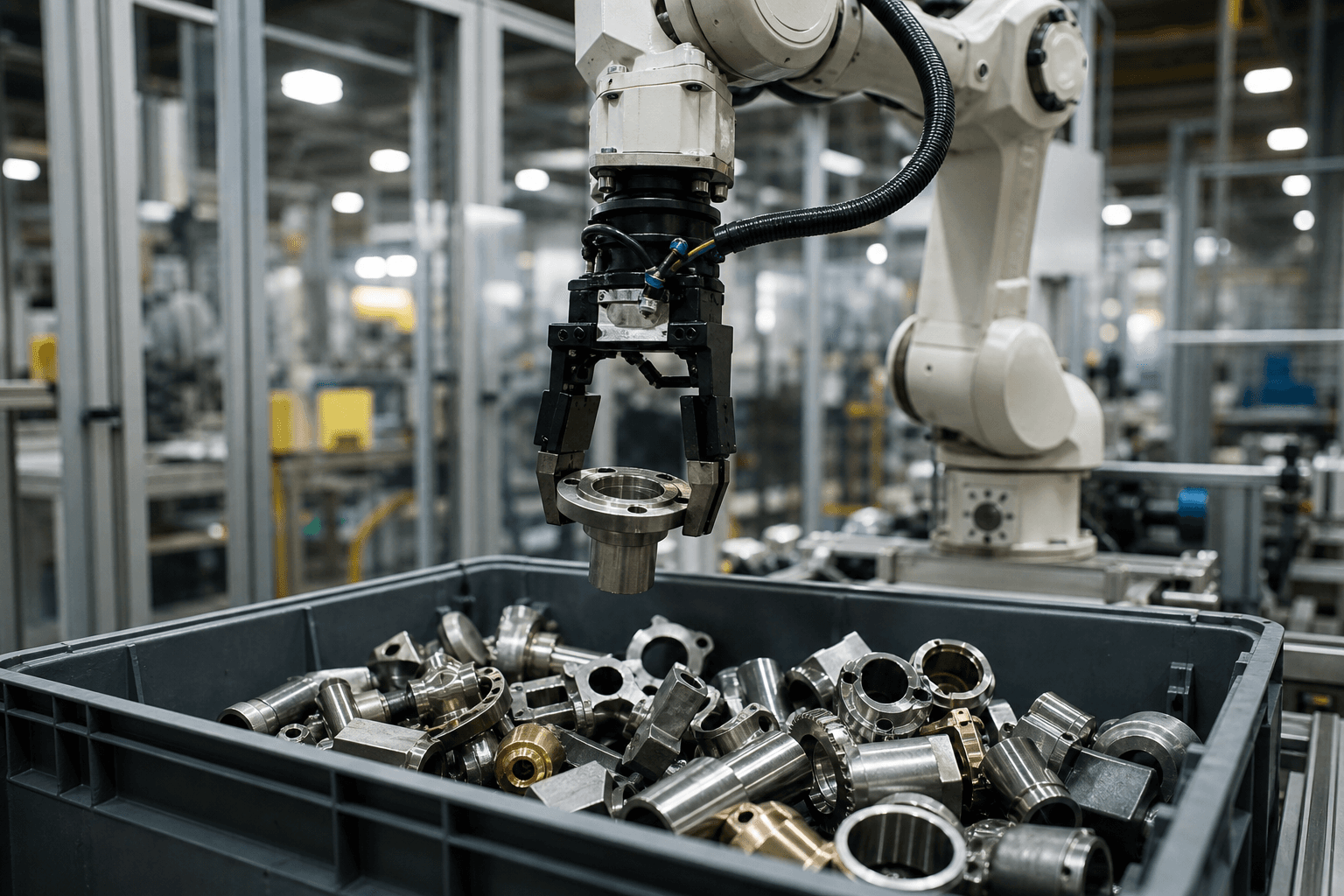
Unstructured pick-from-bin using vision, gripper tooling, and part presentation to feed downstream processes.
Assess this process with Robotic Bin Picking as soft context — the classifier can still suggest a different Technology if your description points elsewhere.
Technology overview
Unstructured pick-from-bin using vision, gripper tooling, and part presentation to feed downstream processes.
Problems it commonly solves
- Manual bin picking causes ergonomic strain, inconsistent presentation, and bottlenecks before assembly or machining.
- Common application: Random bin pick to conveyor
- Common application: Kit presentation for assembly
- Common application: Machine load from mixed bins
Best-fit operating conditions
- Parts can be gripped with feasible tooling despite moderate variation
- Manual bin picking limits upstream/downstream throughput
Poor-fit conditions
- Extremely fragile or entangled parts without reliable separation
- Daily part mix changes faster than vision re-teach capacity
Five-question suitability screen
Answer yes, no, or unknown. Results are deterministic planning guidance — not final feasibility.
1. Is the target process repeatable enough to automate?
Why it matters: One-off or highly variable work often fails early fit checks.
2. Can you share basic throughput, quality, or labour targets?
Why it matters: Without targets, preliminary assessment and supplier scope stay vague.
3. Do you know the main site or layout constraints?
Why it matters: Space, utilities, and safety zoning change delivery roles and cost drivers.
4. Is there a clear equipment or process interface for automation?
Why it matters: Missing interfaces are a common blocker for quotes and validation.
5. Is an internal owner available for validation and recovery planning?
Why it matters: Buyer participation during validation is required for acceptance criteria.
Inputs required for preliminary assessment
Checklist of core and supporting inputs for Robotic Bin Picking. Copy, print, or save locally; open Studio to attach this Technology to an Automation Project.
Required core inputs
This pathway is an early planning guide. It is not a final feasibility review, engineering design, safety certification, supplier quote, or statement of work.
Main technical variables
- Part geometry and weight range
- Bin fill level and part mix
- Required pick rate and uptime
- Downstream presentation requirements
Typical solution stack
- Industrial robot with adaptive gripper
- 2D/3D vision and lighting
- Bin presentation and refill strategy
- Pick verification and reject handling
Required delivery roles
- Robotics integrator
- Vision supplier
- Gripper specialist
- Controls engineer
Common cost drivers
- Cost and timeline depend on site readiness, integration scope, and validation effort. Use the cost drivers below for early planning — not as a quote.
Common project risks
- Part similarity or nesting drives false picks
- Bin refill discipline affects uptime assumptions
- Vision tuning timeline longer than expected for part mix
Site-readiness considerations
- Cell guarding and reach for bin sizes
- Vision-friendly lighting environment
- Operator access for bin refill and recovery
Validation activities
- Pick success rate benchmarked on representative bins
- Lighting and part pose variation tested
- Recovery path for double-picks or misses defined
Typical supplier exclusions
- Scope may exclude projects dominated by: Extremely fragile or entangled parts without reliable separation
- Scope may exclude projects dominated by: Daily part mix changes faster than vision re-teach capacity
- Safety certification, permits, and legal compliance sign-off remain the buyer’s / AHJ responsibility.
- Named supplier recommendations or rankings are out of scope for this planning guide.
Example acceptance criteria
- Pick success rate benchmarked on representative bins
- Lighting and part pose variation tested
- Recovery path for double-picks or misses defined
Questions to ask suppliers
- What evidence will you provide that: Pick success rate benchmarked on representative bins?
- What evidence will you provide that: Lighting and part pose variation tested?
- What is explicitly excluded from your proposal (booth, utilities, fixtures, training, spare parts)?
- What buyer-furnished items or site conditions do you assume?
Related Automation Use Cases
Related listed providers
Browse listed providers related to this pathway in alphabetical order. Listings are basic public company information — not rankings, endorsements, fit scores, or recommendations.
Browse listed providers related to this pathwayInnovation Peer reviews your Automation Project privately with an Innovation Peer advisor. No supplier introduction happens without your approval.
Start a preconfigured process assessment with Robotic Bin Picking as context.