
Humanoid Logistics Robot
Biped humanoid robots for tote handling, trailer unloading, and flexible movement in existing warehouse layouts.
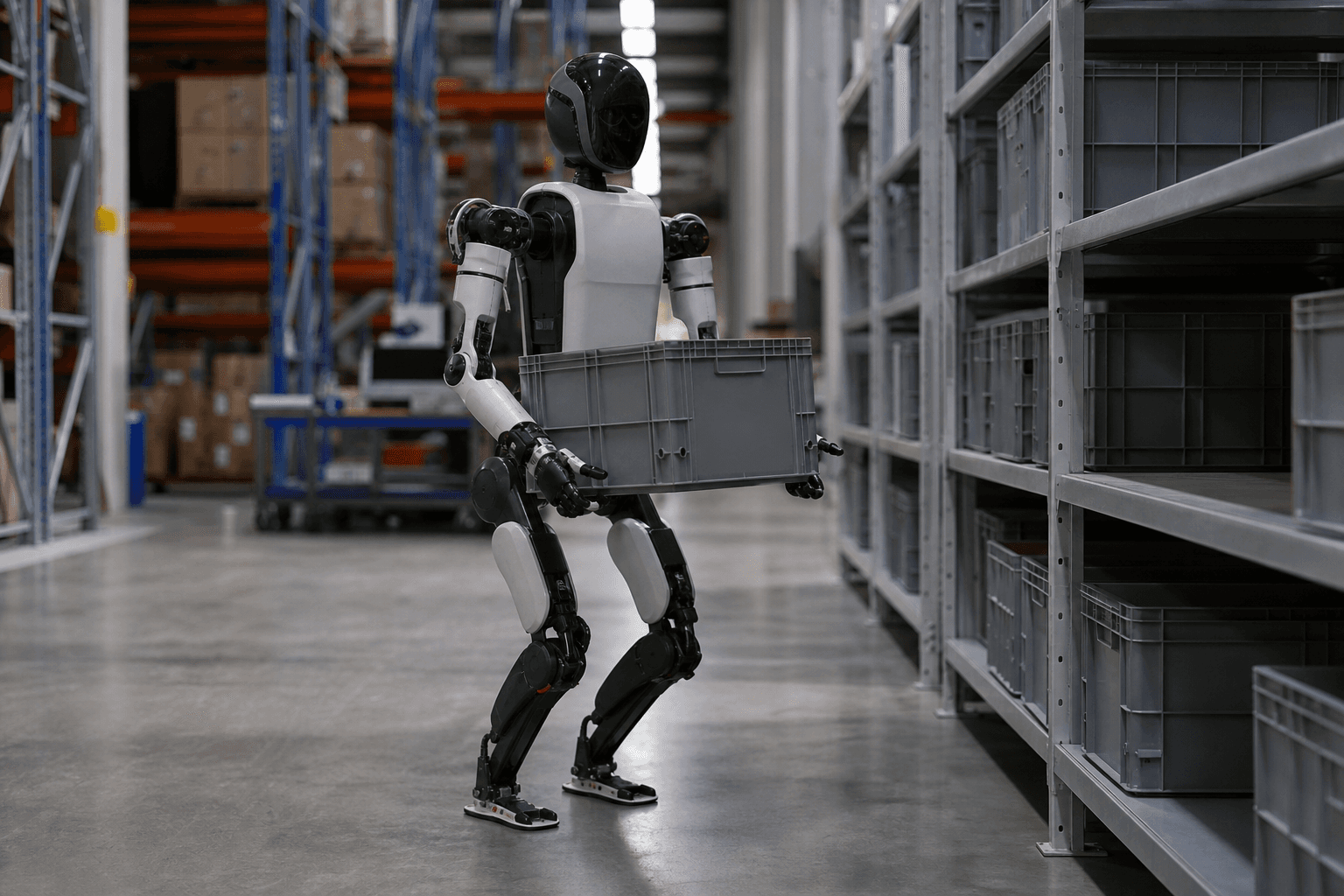
Assess this process with Humanoid Logistics Robot as soft context — the classifier can still suggest a different Technology if your description points elsewhere.
Technology overview
Biped humanoid robots for tote handling, trailer unloading, and flexible movement in existing warehouse layouts.
Problems it commonly solves
- Traditional AMRs and fixed automation struggle with stairs, docks, and human-scale workspaces built for people—not purpose-built robot fleets.
- Common application: Tote and case movement between stations
- Common application: Trailer and container unload support
- Common application: Flexible pick-and-place in mixed layouts
- Common application: Shift-end replenishment in existing aisles
Best-fit operating conditions
- You need human-scale mobility in layouts built for people
- Trailer unload or tote workflows are hard to automate with conventional AMRs
Poor-fit conditions
- Heavy payloads exceed humanoid platform limits
- A fixed AMR or conveyor path would be simpler and cheaper
Five-question suitability screen
Answer yes, no, or unknown. Results are deterministic planning guidance — not final feasibility.
1. Is the target process repeatable enough to automate?
Why it matters: One-off or highly variable work often fails early fit checks.
2. Can you share basic throughput, quality, or labour targets?
Why it matters: Without targets, preliminary assessment and supplier scope stay vague.
3. Do you know the main site or layout constraints?
Why it matters: Space, utilities, and safety zoning change delivery roles and cost drivers.
4. Is there a clear equipment or process interface for automation?
Why it matters: Missing interfaces are a common blocker for quotes and validation.
5. Is an internal owner available for validation and recovery planning?
Why it matters: Buyer participation during validation is required for acceptance criteria.
Inputs required for preliminary assessment
Checklist of core and supporting inputs for Humanoid Logistics Robot. Copy, print, or save locally; open Studio to attach this Technology to an Automation Project.
Required core inputs
This pathway is an early planning guide. It is not a final feasibility review, engineering design, safety certification, supplier quote, or statement of work.
Main technical variables
- Typical load weights and dimensions
- Floor surfaces, ramps, and dock layouts
- Shift patterns and task cycle times
- Integration needs with WMS or MES
Typical solution stack
- Biped humanoid mobile manipulator
- Perception and grasp planning
- Fleet scheduling and task orchestration
- Safety zoning and human-robot coexistence controls
Required delivery roles
- Humanoid robotics vendor or integrator
- Warehouse operations lead
- Controls and safety engineer
- IT and WMS integration partner
Common cost drivers
- Cost and timeline depend on site readiness, integration scope, and validation effort. Use the cost drivers below for early planning — not as a quote.
Common project risks
- Early-generation platforms may have limited payload or uptime
- Task programming takes longer than fixed AMR routes
- Human-scale workspaces still need safety zoning discipline
Site-readiness considerations
- Clear travel paths without trip hazards
- Charging infrastructure near work zones
- Operator and maintenance training plan
Validation activities
- Pilot tasks defined with measurable throughput targets
- Fall-recovery and manual takeover procedures documented
- Battery runtime validated across a full shift pattern
Typical supplier exclusions
- Scope may exclude projects dominated by: Heavy payloads exceed humanoid platform limits
- Scope may exclude projects dominated by: A fixed AMR or conveyor path would be simpler and cheaper
- Safety certification, permits, and legal compliance sign-off remain the buyer’s / AHJ responsibility.
- Named supplier recommendations or rankings are out of scope for this planning guide.
Example acceptance criteria
- Pilot tasks defined with measurable throughput targets
- Fall-recovery and manual takeover procedures documented
- Battery runtime validated across a full shift pattern
Questions to ask suppliers
- What evidence will you provide that: Pilot tasks defined with measurable throughput targets?
- What evidence will you provide that: Fall-recovery and manual takeover procedures documented?
- What is explicitly excluded from your proposal (booth, utilities, fixtures, training, spare parts)?
- What buyer-furnished items or site conditions do you assume?
Related listed providers
Browse listed providers related to this pathway in alphabetical order. Listings are basic public company information — not rankings, endorsements, fit scores, or recommendations.
Browse listed providers related to this pathwayInnovation Peer reviews your Automation Project privately with an Innovation Peer advisor. No supplier introduction happens without your approval.
Start a preconfigured process assessment with Humanoid Logistics Robot as context.