
CNC Machine Tending
Robotic or collaborative loading and unloading of CNC mills, lathes, and machining centers.
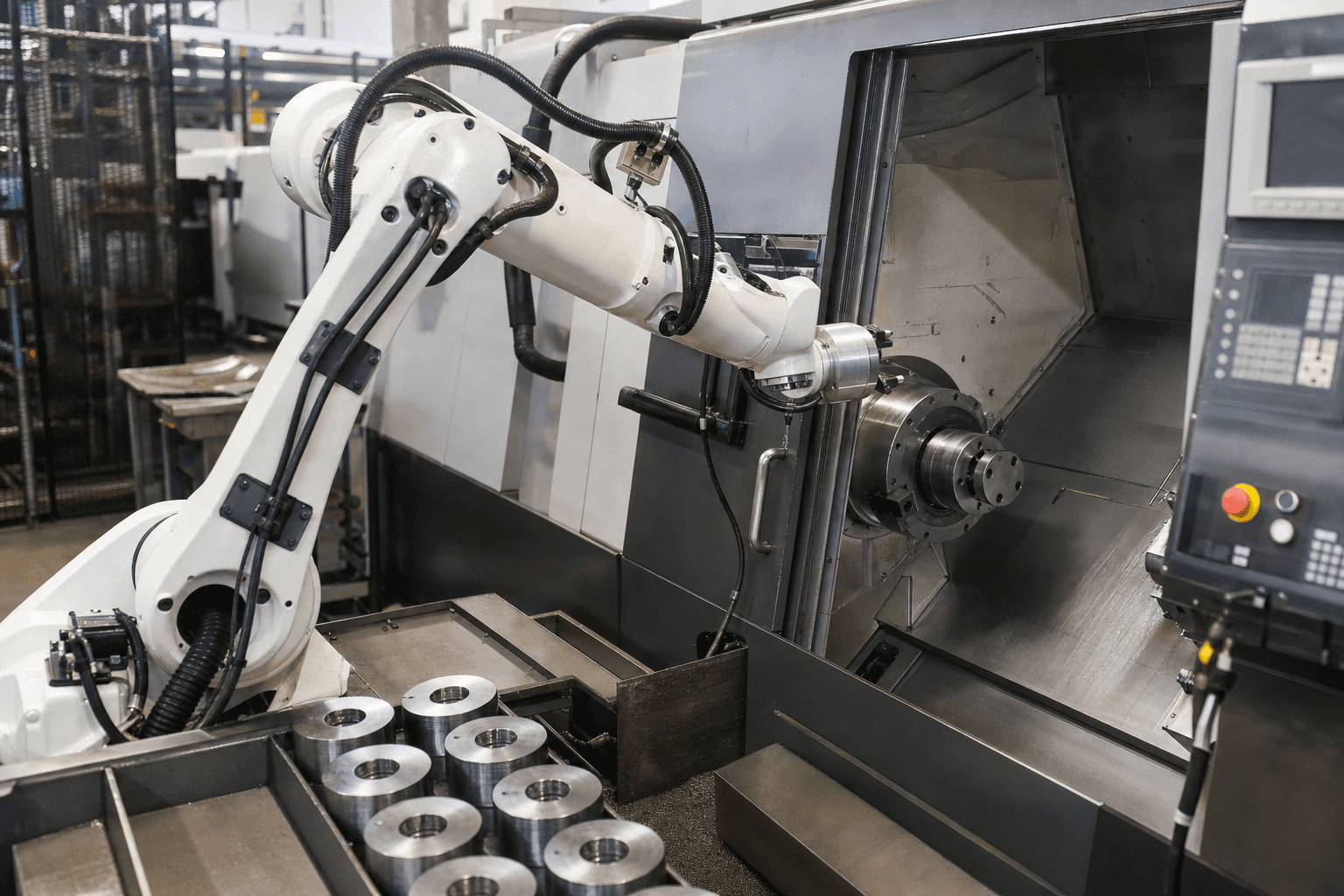
Tell us about your machine tending process. If another approach fits your description better, we will say so.
Technology Overview
Robotic or collaborative loading and unloading of CNC mills, lathes, and machining centers.
Problems It Commonly Solves
- Spindle idle time, operator-attended load/unload, and ergonomic risk on repetitive machining cells.
- Common application: Single-spindle CNC mill tending
- Common application: Dual lathe load/unload
- Common application: Multi-machine cell tending
Suitable Conditions
- Repeatable part families with defined load/unload windows
- Operator-attended time limits spindle utilization
- Ergonomic or staffing pressure on tending tasks
Constraints to Investigate
- Highly variable one-off parts with no repeatable presentation
- Machine controls cannot support safe automated door/cycle integration
- Floor space cannot accommodate robot reach and guarding
Project Readiness Check
These questions ask whether you already have the information. Answer yes, no, or not sure. A no means information to gather. It does not mean the automation opportunity failed.
1. Do you know the part families and how they are presented to the machine?
Why it matters: Presentation decides whether a loader is practical.
2. Do you know the load and unload time compared with the machining cycle?
Why it matters: That comparison shows where spindle time is being lost.
3. Do you know which machine signals or door cycles a loader would need?
Why it matters: The machine interface is a common missing input.
4. Do you know the space around the machine for a loader and guarding?
Why it matters: Space decides whether a cell can sit at the machine.
5. Do you know who would clear faults and change parts?
Why it matters: Someone still has to recover the cell.
Inputs required for preliminary assessment
Checklist of core and supporting inputs for CNC Machine Tending. Copy, print, or save locally; open Studio to attach this Technology to an Automation Project.
Required core inputs
Optional supporting inputs
Evidence to gather
- Machine make/model and control photo or OEM sheet
- Part samples or CAD for launch family
- Video of current load/unload cycle
- Floor layout sketch with clearances
This pathway is an early planning guide. It is not a final feasibility review, engineering design, safety certification, supplier quote, or statement of work.
Main Technical Variables
- CNC machine type / make-model
- Part family and geometry mix
- Part weight range
- Machine cycle time
- Part presentation / infeed method
- Machine interface engineering
- Custom gripper and nest
- Guarding and safety circuit
Typical Solution Stack
- Industrial or collaborative robot
- Gripper and infeed/outfeed staging
- Machine door interlocks and cycle-start integration
- Safety guarding and recovery procedures
Required Delivery Roles
- Robotics integrator
- CNC interface / machine tool partner
- Controls engineer
- Safety reviewer
Common Cost Drivers
- Machine interface engineering
- Custom gripper and nest
- Guarding and safety circuit
- Infeed/outfeed staging
Cost and schedule usually move with: Machine interface engineering; Custom gripper and nest; Guarding and safety circuit; Infeed/outfeed staging. Treat any public ranges as illustrative planning context only. They are not a quote.
Common Project Risks
- Machine door interlock / cycle-start interface delays if OEM docs are incomplete.
- Gripper and nest may not cover full part-family mix without redesign.
- Cycle-overlap assumptions fail when load time exceeds cut time.
- Chip and coolant contamination affecting gripper reliability
Site-Readiness Considerations
- Adequate robot reach and floor clearance
- Power and compressed air available
- Operator access maintained for exceptions
- Validate machine door interlocks and lockout for robot-attended cells.
- Confirm operator egress and emergency stop zoning early.
Validation Activities
- Door interlock and cycle-start verified on the actual control
- Gripper and nest proven on the launch part family
- Misload recovery procedure timed and documented
Scope to Confirm With Suppliers
- Confirm which equipment, tooling, and software are included in the proposal.
- Confirm whether installation, commissioning, and operator training are included.
- Confirm which utilities, guarding, fixtures, and site work stay with your team.
- Confirm spare parts, documentation, and the support period.
- Confirm how acceptance will be tested before handover.
Example Acceptance Criteria
- Agree the test parts, rate, and quality checks before installation.
- Agree who signs off and what happens if a test is not met.
Questions to Ask Suppliers
- What load and unload time can the proposal hold alongside the machining cycle?
- How will the loader interface with our machine door, cycle start, and safety circuits?
- Which gripper and part-presentation arrangement would you propose for our part families?
- What footprint, utilities, and guarding does the cell need?
- Who provides fixtures, programming, installation, and operator training?
- How will operators recover from a misload or a machine alarm?
- How will we agree and test acceptance criteria?
Related Automation Use Cases
Related Listed Providers
Browse listed providers related to this pathway in alphabetical order. Listings are basic public company information. They are not rankings, endorsements, fit scores, or recommendations.
Browse listed providers for this technologyInnovation Peer reviews your Automation Project privately with an Innovation Peer advisor. No supplier introduction happens without your approval.
Tell us about your machine tending process. If another approach fits your description better, we will say so.