
AMRs / AGVs
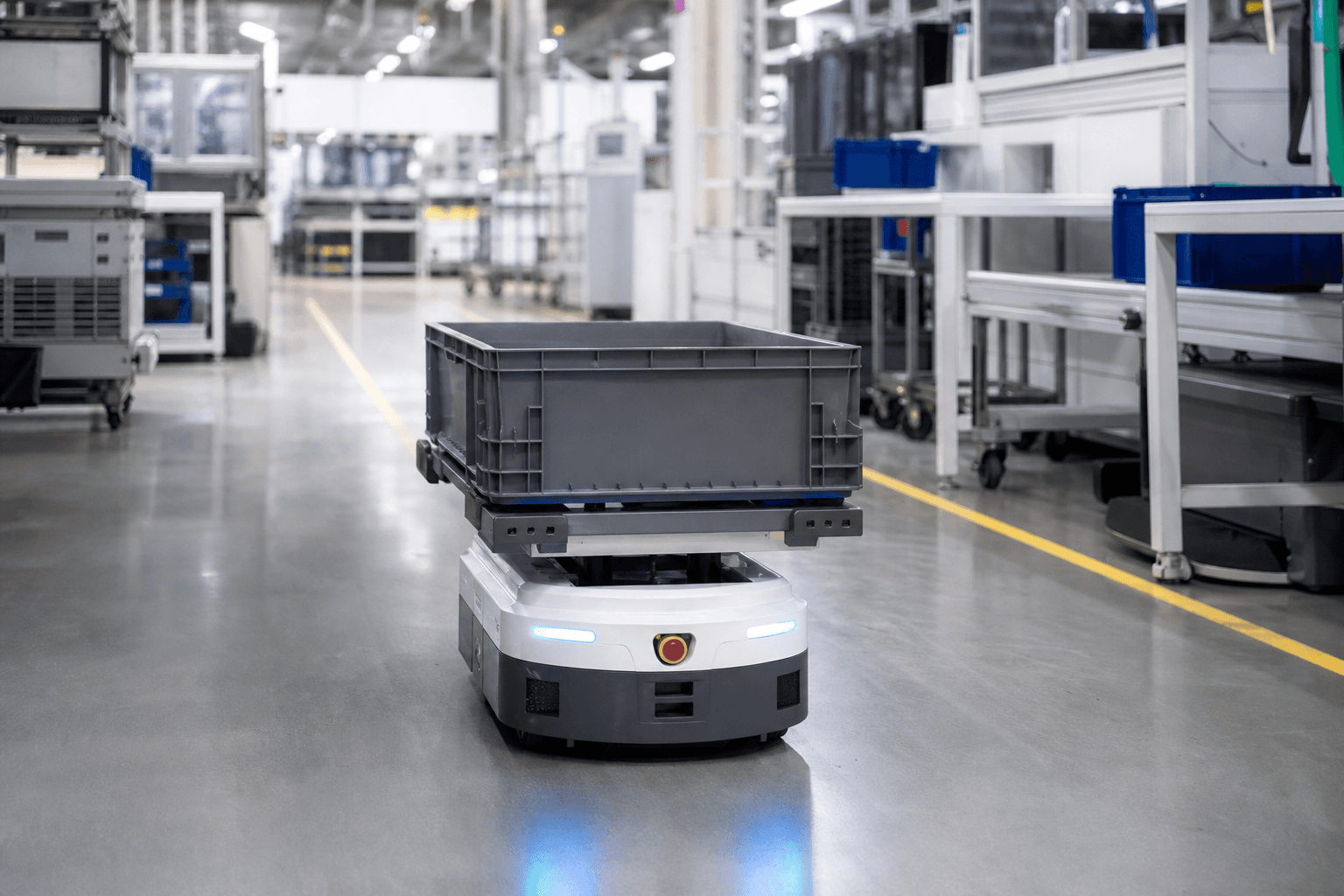
Autonomous mobile robots and AGVs for internal material transport between cells and warehouse.
Tell us about your process for AMRs / AGVs. If another approach fits your description better, we will say so.
Technology Overview
Autonomous mobile robots and AGVs for internal material transport between cells and warehouse.
Problems It Commonly Solves
- Forklift and cart congestion, WIP delays between warehouse and production, and unpredictable internal logistics.
- Common application: Warehouse tote delivery
- Common application: WIP transport between cells
- Common application: Kitting loops
Suitable Conditions
- Repeatable routes between defined pick and drop points
- WIP buffers benefit from predictable internal delivery
Constraints to Investigate
- Uncontrolled pedestrian/forklift traffic without separation plan
- Loads exceed AMR payload or require special handling
Project Readiness Check
These questions ask whether you already have the information. Answer yes, no, or not sure. A no means information to gather. It does not mean the automation opportunity failed.
1. Do you know the routes, distances, and handoff points?
Why it matters: Routes define the movement problem.
2. Do you know the load size, weight, and how it is picked up today?
Why it matters: Payload and pickup method change the vehicle choice.
3. Do you know the floor, doors, and traffic a vehicle would meet?
Why it matters: Site conditions are part of the scope, not a later detail.
4. Do you know how many moves happen in a typical shift?
Why it matters: Move count is needed before a fleet size means anything.
5. Do you know who would manage charging, exceptions, and map changes?
Why it matters: Operation of the system is part of the project.
Inputs required for preliminary assessment
Checklist of core and supporting inputs for AMRs / AGVs & Internal Material Movement. Copy, print, or save locally; open Studio to attach this Technology to an Automation Project.
Required core inputs
Optional supporting inputs
Evidence to gather
- Facility map with routes and aisles
- Load photos and weights
- Move volume by shift
- Wi-Fi heat map or coverage notes if available
This pathway is an early planning guide. It is not a final feasibility review, engineering design, safety certification, supplier quote, or statement of work.
Main Technical Variables
- Load type and weight
- Travel routes / distances
- Traffic and aisle constraints
- Pick/drop and handoff points
- Move volume / frequency
- Fleet size and charging infrastructure
- Route mapping and traffic zoning
- Pick/drop station hardware
Typical Solution Stack
- AMR/AGV fleet and charging
- Fleet manager and traffic rules
- Pick/drop stations and handoff points
- WMS or MES trigger integration
Required Delivery Roles
- AMR/AGV vendor
- Systems integrator
- WMS/MES liaison
Common Cost Drivers
- Fleet size and charging infrastructure
- Route mapping and traffic zoning
- Pick/drop station hardware
- WMS/MES integration
Cost and schedule usually move with: Fleet size and charging infrastructure; Route mapping and traffic zoning; Pick/drop station hardware; WMS/MES integration. Treat any public ranges as illustrative planning context only. They are not a quote.
Common Project Risks
- Wi-Fi dead zones interrupt fleet coordination.
- Forklift and AMR traffic conflicts without zoning rules.
Site-Readiness Considerations
- Floor condition suitable for AMR navigation
- Wi-Fi or fleet network coverage
- Pedestrian and forklift traffic separation plan
- Validate charging and emergency stop procedures for mixed traffic areas.
Validation Activities
- Route mapping and traffic rules validated
- Charging strategy confirmed under peak moves
- Handoff points defined with manual fallback
Scope to Confirm With Suppliers
- Confirm which equipment, tooling, and software are included in the proposal.
- Confirm whether installation, commissioning, and operator training are included.
- Confirm which utilities, guarding, fixtures, and site work stay with your team.
- Confirm spare parts, documentation, and the support period.
- Confirm how acceptance will be tested before handover.
Example Acceptance Criteria
- Agree the test parts, rate, and quality checks before installation.
- Agree who signs off and what happens if a test is not met.
Questions to Ask Suppliers
- What vehicle type, payload, and fleet size are you assuming?
- How will pickups and drop-offs work with our current racks, carts, or conveyors?
- What floor, door, and traffic conditions does the proposal assume?
- What maps, charging, software, and IT connections are included?
- Who handles installation, traffic rules, and operator training?
- How will we agree and test acceptance criteria on our routes?
Related Automation Use Cases
Related Listed Providers
Browse listed providers related to this pathway in alphabetical order. Listings are basic public company information. They are not rankings, endorsements, fit scores, or recommendations.
Browse listed providers for this technologyInnovation Peer reviews your Automation Project privately with an Innovation Peer advisor. No supplier introduction happens without your approval.
Tell us about your process for AMRs / AGVs. If another approach fits your description better, we will say so.